
Download library
Greenhouse Watering Schedule Template: 7 Essential Tips to Keep Your Plants Thriving Now
Master greenhouse watering with our customizable schedule template. Learn 7 essential tips for proper timing, water amounts, and irrigation systems to keep your plants healthy year-round.
Precision irrigation translates directly into plant health, energy savings, and labor efficiency. This template consolidates the soil-water balance approach, crop-specific evapotranspiration (ET) benchmarks, and system-level consumption so you can schedule irrigation by evidence—not guesswork. Use it to separate the volumes you feed to crops from the water you spend on cooling and environmental control, then adjust the plan as the season, root-zone volume, and canopy size change.
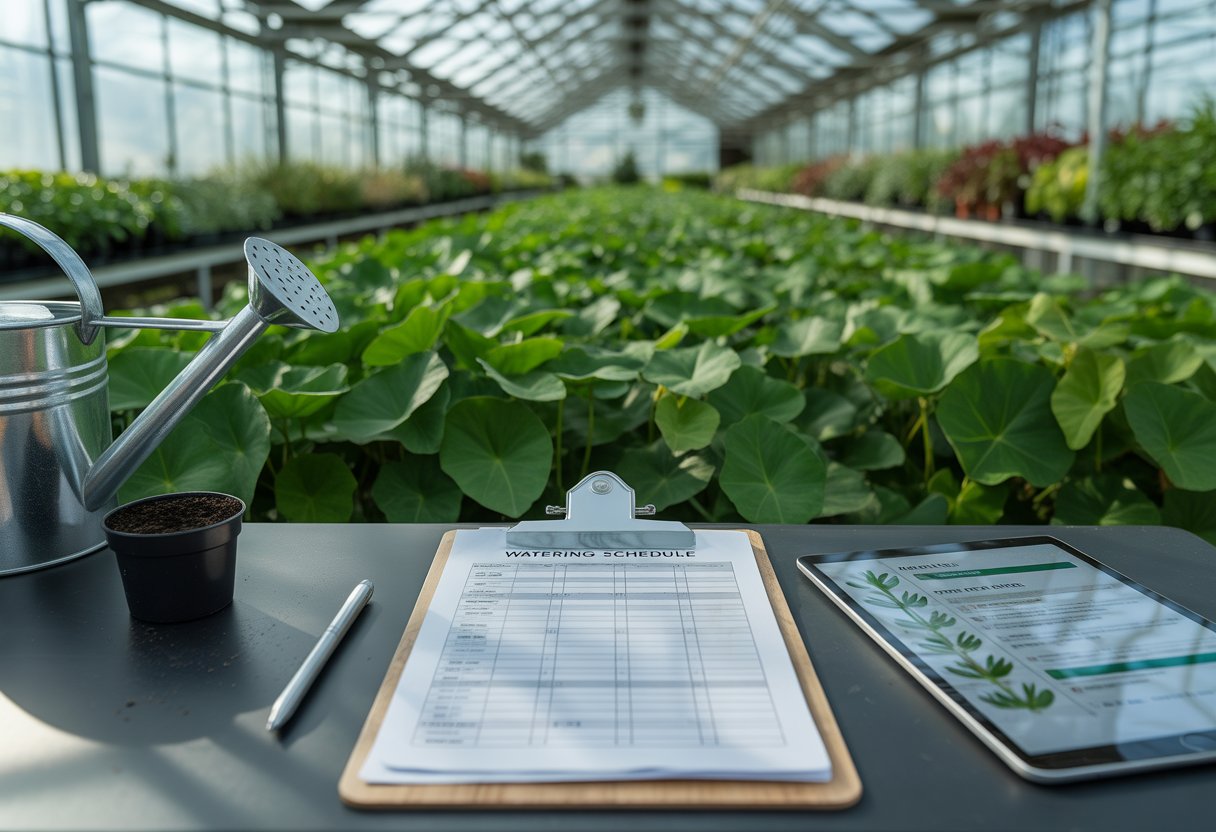
How to put this template to work
Follow these four steps every time you prepare or revise the schedule. The worksheet in the downloadable PDF mirrors the fields described below.
- Quantify the root-zone reservoir. Use the water-balance method to track available water in each crop zone. Update the soil water deficit daily and trigger irrigation when the deficit reaches your management allowed depletion (MAD) threshold.[^1][^2]
- Import crop benchmarks. Start with the daily ET targets below, then tune volumes using leachate measurements or substrate moisture sensors.
- Budget process water separately. Pad-and-fan or fog system demand can match or exceed crop water use. Log it as a distinct line item so pumps, storage, and make-up water are sized correctly.[^3]
- Log actuals and exceptions. Record run times, flow rates, and any observed stress (wilting, blossom-end rot, tip burn). The notes reveal when to adjust frequency, emitter spacing, or your MAD value.
Crop-specific greenhouse benchmarks
Use these values to initialise the schedule for mature crops under typical summer conditions. Add your own data once you measure leachate volumes and EC.
| Crop (growth stage) | Daily irrigation target | Notes | | ------------------------------------------------- | -------------------------------------------------------------------------------- | -------------------------------------------------------------------------- | | Tomato (fruiting, soilless media) | 2.0–2.5 quarts (1.9–2.4 L) per plant per day | UF/IFAS scheduling guidance; increase event count as fruit load peaks.[^4] | | Cucumber (fruiting, nutrient film or bag culture) | 1–2 gallons (3.8–7.6 L) per plant per day | University of Alaska CES recommendations for full-yield vines.[^5] | | Lettuce (hydroponic head lettuce) | 24–214 mL per head per day; minimum 1.4 L per 5 g dry weight to prevent tip burn | ASAE research on greenhouse ET rates.[^6] |
MAD and event design
- Set MAD by crop: 35–45% for fast-growing leafy crops, 45–55% for fruiting vine crops. Lower MAD when rooting volume or container size shrinks.
- Translate MAD into runtime: If the substrate holds 1.8 L per plant and MAD is 40%, irrigate once the deficit reaches 0.72 L. With emitters flowing at 1.5 L/hour you need roughly 29 minutes of runtime to refill the zone. Split this across multiple pulses to keep EC stable and prevent leaching.
Document the full facility water demand
Cooling systems and sanitation can eclipse crop irrigation. Include these lines in your schedule so you avoid starving cooling pads or running pumps dry.
| Demand category | Planning figure | Template action | | ---------------------------------- | --------------------------------------------------------------------------------------- | -------------------------------------------------------------------------- | | Pad-and-fan evaporative cooling | Average 11 gallons per minute per acre (≈8,000 gal/acre/day when operated 12 hours)[^3] | Add hourly entries for cooling water and verify make-up supply capacity. | | Misting/fogging for propagation | 0.5–1.0 gallons per bench per cycle (varies by nozzle) | Link mist cycles to the propagation worksheet so you can budget peak draw. | | Equipment wash-down and sanitation | 1–2% of weekly irrigation volume | Store in a separate log to avoid inflating crop demand. |
Template fields to populate
| Field | Why it matters | | ------------------------------------------- | ----------------------------------------------------------------------------------------- | | Crop zone & variety | Enables rotation of water-balance data and records cultivar-specific adjustments. | | Substrate volume & available water capacity | Required to calculate MAD thresholds and runtime. | | Irrigation method & flow rate | Determines pulse length and helps diagnose uneven distribution. | | Daily ET target & MAD (%) | Combines benchmark data with your risk tolerance for stress. | | Scheduled events (time, duration) | Keeps automated controllers and manual crews aligned. | | Actual volume applied & leachate EC | Confirms whether you are replacing the calculated deficit without salinity spikes. | | Cooling/process water | Prevents pad systems from depleting irrigation storage unexpectedly. | | Observations & corrective actions | Documents canopy symptoms, equipment faults, or weather anomalies for future adjustments. |
Example weekly framework
| Day | 06:30 | 09:30 | 12:00 | 15:00 | 18:00 | Notes | | --- | --------------------- | ---------------------- | ----------------- | ---------------------- | ---------------------- | --------------------------------------------------- | | Mon | Tomato zone A – 6 min | Lettuce raft 1 – 3 min | Cooling pad flush | Tomato zone A – 6 min | Cucumbers – 8 min | Adjusted lettuce MAD to 35% after high humidity. | | Tue | Cucumbers – 8 min | Lettuce raft 1 – 3 min | Cooling pad flush | Tomato zone B – 6 min | Lettuce raft 2 – 3 min | Logged 12% leachate; reduce noon pulse by 1 minute. | | Wed | Tomato zone A – 6 min | Cucumbers – 8 min | Cooling pad flush | Lettuce raft 1 – 3 min | Tomato zone B – 6 min | Scheduled fertigation; added leachate EC check. |
Implementation checklist
For automated systems
- Calibrate flow meters quarterly and compare totals to the schedule.
- Program alarms if cumulative volume exceeds the MAD-derived budget by more than 10%.
- Sync controller logs to the inventory or ERP system so fertilizer and labor allocations match water use.
For manual irrigation
- Use color-coded hoses or manifolds tied to crop zones to avoid cross-over.
- Record start/stop times immediately; mobile forms reduce transcription gaps.
- Verify substrate weight at the start of each shift to confirm MAD has not been exceeded overnight.
References
[^1]: Colorado State University Extension. Irrigation Scheduling: The Water Balance Approach (Fact Sheet 4.707). https://extension.colostate.edu/resource/irrigation-scheduling-the-water-balance-approach/
[^2]: University of Minnesota Extension. Basics of Irrigation Scheduling. https://extension.umn.edu/irrigation/basics-irrigation-scheduling
[^3]: Bilderback, D., Dole, J., & Sneed, R. (North Carolina State University). Water Supply and Water Quality for Nursery and Greenhouse Crops (HIL-557). https://nurserycrops.ces.ncsu.edu/wp-content/uploads/2017/11/water-supply-and-water-quality-for-nursery-GH-crops-Bilderback-dole-sneed.pdf
[^4]: Hochmuth, G. & Hochmuth, R. (2023). Water and Nutrient Management Guidelines for Greenhouse Hydroponic Crops. UF/IFAS Extension, EDIS HS1274. https://edis.ifas.ufl.edu/publication/HS1274
[^5]: University of Alaska Fairbanks Cooperative Extension Service. Growing Cucumbers in Greenhouses. https://www.uaf.edu/ces/publications/database/gardening/growing-cucumbers-greenhouses.php
[^6]: Ciolkosz, D., Albright, L., & Phelan, P. (1998). Characterizing Evapotranspiration in a Greenhouse Lettuce Crop. Transactions of the ASAE, 41(5), 1489–1494.