
Download library
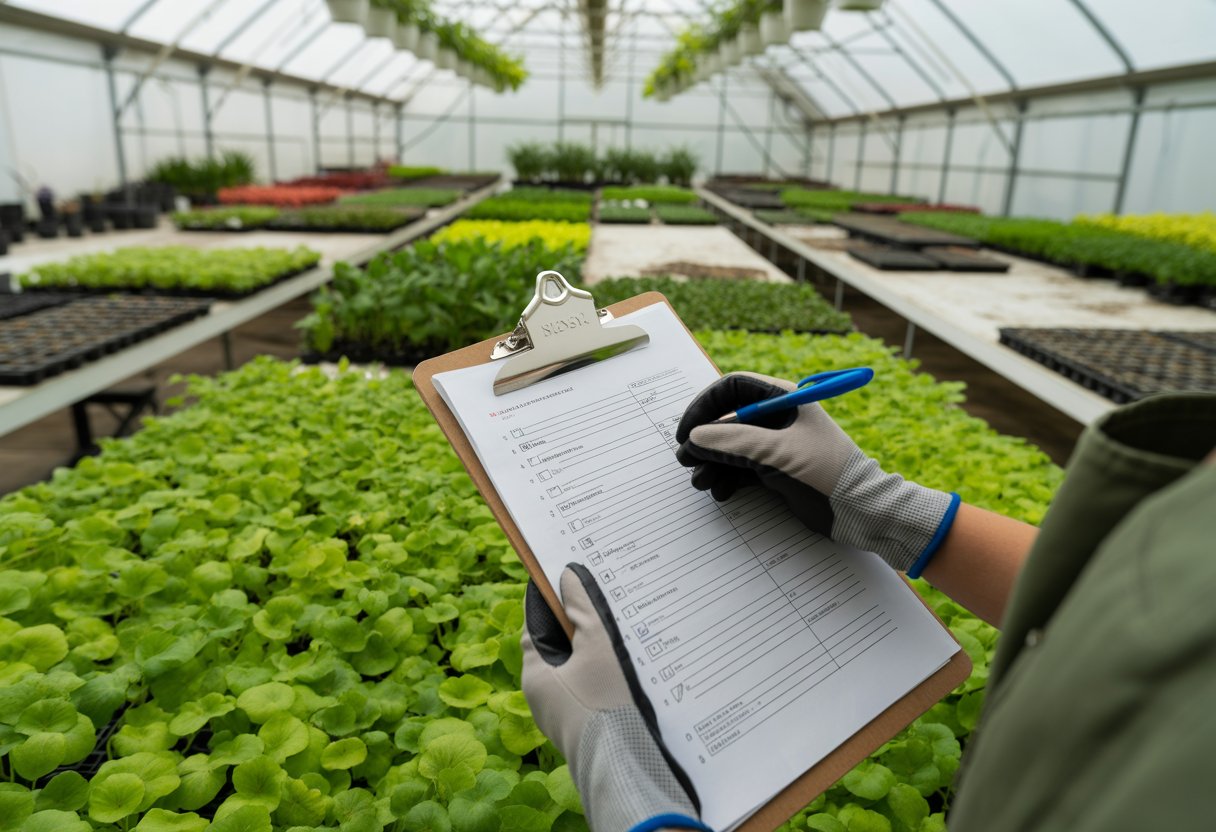
Greenhouse Inventory Checklist: 10 Must-Have Items for a Thriving Garden Today
Never run out of supplies again! Our comprehensive greenhouse inventory checklist covers essential tools, supplies, and equipment to keep your greenhouse running efficiently year-round.
Thin operating margins make inventory control mission-critical for greenhouse enterprises. University of Florida enterprise budgets for hydroponic tomatoes show negative net income once labor (18.6% of variable cost) and fixed overhead are included, even at $0.90 per pound pricing.[^1] If supplies, plants, and finished goods sit on the bench too long, the cash to cover labor, energy, and inputs disappears. This checklist turns your storage areas into a data source so you can align purchasing, production planning, and cash flow.
Key performance indicators to track alongside the checklist
| KPI | Formula | Why it matters | | ------------------------------ | ----------------------------------------------------------------- | ----------------------------------------------------------------------------------------------------------------------------------------------------------------------------------------- | | Inventory turnover ratio | Cost of goods sold ÷ Average inventory value[^2] | Measures how often you sell through your stock. A low ratio signals excess inventory tying up cash or plant material aging past its prime. | | Inventory-to-sales ratio | Inventory value ÷ Monthly sales | U.S. retailers averaged ~1.3 throughout 2024, which equates to roughly 40 days of supply.[^3] Use this as an upper limit for durable goods; live plants should turn substantially faster. | | Inventory delta vs. net profit | (Ending inventory – Beginning inventory) compared with net profit | If inventory growth outpaces profit (common in greenhouse budgets[^1]), you are consuming cash even when the income statement looks positive. |
Inventory categories covered in the template
| Category | Examples | Tracking focus | | ------------------------- | -------------------------------------------------- | ---------------------------------------------------------------------------- | | Plant material | Seed, plugs, rooted cuttings, finished plants | Propagation date, supplier, variety, expected ship/pot-up date, loss factor. | | Growing media & nutrition | Potting mix, perlite, coco, fertilizers, injectors | Lot numbers, EC/pH specs, on-hand volume vs. reorder point. | | Packaging & merchandising | Pots, trays, tags, sleeves, retail signage | Seasonal demand spikes, supplier lead times, storage location. | | Infrastructure & tools | Benches, lights, sensors, sprayers, PPE | Service interval, calibration date, replacement cost, depreciation schedule. | | Consumables & utilities | Fuel, biological controls, sanitation chemicals | Safety stock, expiration date, regulatory documentation. |
Workflow for maintaining the checklist
- Audit weekly during peak season. Integrate the walk-through with IPM scouting to minimise labor.
- Reconcile quantities with production plans. Link tray counts and pot sizes to the crop schedule so you know when to reorder before a sowing or transplant window.
- Capture shrink and spoilage. Log losses (disease, mechanical damage, expired inputs) separately from sales so you can target process improvements.
- Sync with purchasing and accounting. Feed updated quantities into your purchasing system to prevent duplicate orders and to keep balance sheets accurate.
Template fields
| Field | Description | | -------------------------------- | --------------------------------------------------------------------------------------- | | Item/sku & category | Unique identifier and one of the categories above. | | Supplier & lead time | Supports reorder planning and vendor benchmarking. | | Unit of measure & reorder point | Allows conversion between vendor packs and daily usage. | | On-hand quantity & date verified | Ensures counts are current and timestamps audits. | | Unit cost & extended value | Provides real-time inventory valuation for financial statements. | | Storage location | Bench, cold room, chemical cabinet, etc., to speed picking. | | Status/condition | New, in use, needs repair, expired. | | Notes/actions | e.g., “Rotate stock—batch expiring 15 Aug,” or “Calibrate injector before poinsettias.” |
Cost-control levers to note during inventory checks
- Labor-saving automation. Michigan State University Extension highlights conveyors, transplanting equipment, and shipping tables as proven methods to reduce labor—the largest greenhouse expense.[^4]
- Energy efficiency. Record insulation, curtain systems, heater efficiency, and lighting upgrades as inventory line items. Knowing what you have lets you schedule maintenance that keeps energy use low.
- Product rationalisation. Use turnover data to prune slow-selling SKUs and focus on high-margin crops. Eliminating rarely ordered pot sizes or plant varieties frees cash and shelf space.
- Preventive maintenance. Logging service dates for irrigation injectors, sprayers, and fans reduces emergency repairs and unplanned downtime.
References
[^1]: Smith, J. L., Hewitt, T. D., Hochmuth, R. C., & Hochmuth, G. J. Enterprise Budget and Cash Flow for Greenhouse Tomato Production. University of Florida IFAS Extension (HS792). https://ufdcimages.uflib.ufl.edu/IR/00/00/09/83/00001/CV27000.pdf
[^2]: Investopedia. Inventory Turnover Ratio: What It Is, How It Works, and Formula. https://www.investopedia.com/terms/i/inventoryturnover.asp
[^3]: Federal Reserve Bank of St. Louis. Retailers: Inventories to Sales Ratio (RETAILIRSA). https://fred.stlouisfed.org/series/RETAILIRSA
[^4]: Lindberg, H. (2019). Decreasing Greenhouse Expenses. Michigan State University Extension. https://www.canr.msu.edu/news/decreasing-greenhouse-expenses