
Download library
Greenhouse Crop Rotation Planner: 7 Essential Tips to Boost Your Harvest This Season
Master greenhouse crop rotation with our comprehensive planning guide. Learn 7 essential tips for soil health, pest management, and maximizing yields in your greenhouse year-round.
A year-round greenhouse can produce five to ten crop turns annually, which makes it easy for soil-borne pathogens to build inoculum faster than in outdoor beds. This planner gives you a data-backed structure for rotating plant families, recording sanitation tactics, and enforcing rest periods long enough to knock pathogen populations below damage thresholds. Use it to document what you planted, where, when, and how you cleaned the zone before moving to the next crop.
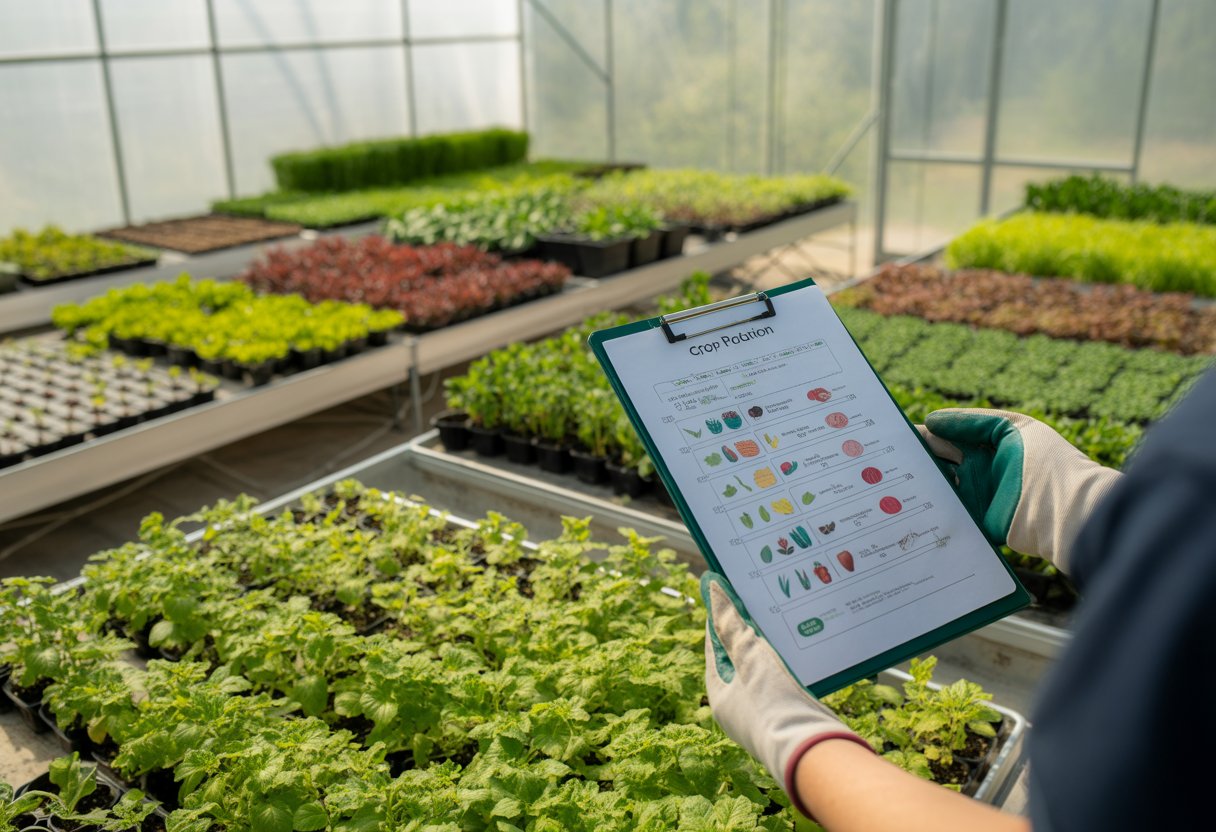
Planner workflow
- Assign zones and families. Divide the greenhouse into management zones and tag each with the plant family currently in production (Solanaceae, Brassicaceae, Fabaceae, etc.).
- Record cultural actions. Each crop entry should include the cultivar, whether it carries disease resistance, sanitation steps, and any soil treatments.
- Schedule the next eligible family. Use the pathogen persistence table to determine the minimum rest interval before replanting a susceptible host.
- Document inspection findings. Capture scouting notes, lab diagnoses, and corrective actions. They provide the evidence you need when adjusting future rotations or introducing resistant varieties.
Core rotation families
| Family | Examples | Notes | | ------------- | ------------------------ | ----------------------------------------------------------------------------------- | | Solanaceae | Tomato, pepper, eggplant | Heavy feeders; share Fusarium, Verticillium, and Phytophthora risks. | | Cucurbitaceae | Cucumber, squash, melon | Susceptible to Fusarium oxysporum f.sp. cucumerinum and Phytophthora capsici. | | Brassicaceae | Cabbage, kale, arugula | Monitor for clubroot; some biofumigant species can host P. capsici (see caution). | | Fabaceae | Beans, peas | Fix atmospheric nitrogen; excellent follow-up after heavy feeders. | | Alliums | Onion, garlic | Helpful for breaks; moderate disease pressure and can suppress some pathogens. |
Pathogen carryover windows
Use these intervals as your minimum rest period before replanting the listed hosts in the same zone. Extend the break when pressure is high or when lab results show abundant survival structures.
| Pathogen & disease | Primary greenhouse host families | Survival structure | Documented persistence | Suggested rotation interval | Sources | | -------------------------------------------- | --------------------------------------- | ------------------ | ---------------------------------------- | ------------------------------------- | -------------------------- | | Fusarium oxysporum (Fusarium wilts) | Solanaceae, Cucurbitaceae | Chlamydospores | Survive "many years" without a host[^1] | 5–7 years when feasible | UKY Extension bulletin[^1] | | Verticillium dahliae (Verticillium wilt) | Solanaceae, Brassicaceae, Cucurbitaceae | Microsclerotia | Up to 10 years in soil[^2] | ≥4 years (longer in infested houses) | MSU Extension[^2] | | Rhizoctonia solani (damping-off, root rot) | Broad host range | Sclerotia | Sclerotia persist for years in soil[^3] | 3–4 years + sanitation | Penn State Extension[^3] | | Phytophthora capsici (Phytophthora blight) | Solanaceae, Cucurbitaceae | Oospores | Oospores persist for 10+ years[^4] | ≥4 years with strict drainage control | NC State Extension[^4] | | Plasmodiophora brassicae (Clubroot) | Brassicaceae | Resting spores | Resting spores viable up to 20 years[^5] | 7+ years in heavily infested soil | Government of Alberta[^5] |
Caution: Biofumigant brassicas such as Brassica juncea can host Phytophthora capsici. Do not use them as cover crops in blocks where that pathogen has been detected.[^6]
Fields to capture in the planner
| Field | Why it matters | | --------------------------------- | ------------------------------------------------------------------------------ | | Zone ID & square footage | Allows you to sequence crops and track productivity per area. | | Crop family & cultivar | Flags resistance packages and shared pathogen risks. | | Planting and termination dates | Drive rotation intervals and help estimate inoculum pressure. | | Soil treatment & sanitation steps | Document steaming, solarization, or disinfectants for audit trails. | | Resistances deployed | e.g., Fol race 1 resistance; informs whether rotation length can be reduced. | | Pathogen detections | Lab results, symptom photos, or scouting notes. | | Next eligible families | Auto-filled from the persistence table to speed planning. |
Integrated management notes
- Combine rotation with resistant cultivars. Many modern tomato and pepper cultivars carry Fusarium and Verticillium resistance. Record the resistance package so you know when you can safely shorten a rotation interval.
- Sanitize between turns. Remove plant debris, pressure-wash benches, and disinfect tools to avoid moving inoculum between zones. Soil clinging to tools or cart wheels can negate the rotation benefits.
- Use biological or steaming treatments wisely. Soil steaming, solarization, or biological amendments reduce inoculum density but rarely eliminate the need for rotation. Log treatment temperatures, exposure times, and products so you can correlate them with future disease levels.
- Monitor nutrient balance. Alternate heavy feeders with legumes or leafy greens to balance nitrogen drawdown and organic matter inputs. Incorporate cover crops or inoculated media where space allows.
Example rotation roadmap
| Year | Winter crop | Spring crop | Summer crop | Autumn crop | Notes | | ---- | -------------------- | ------------------------ | -------------------- | ----------------- | ------------------------------------------------------------------------- | | 2025 | Lettuce (Asteraceae) | Tomato (Solanaceae) | Basil (Lamiaceae) | Beans (Fabaceae) | Zone sanitized with peroxide foam between tomato and basil. | | 2026 | Kale (Brassicaceae) | Cucumber (Cucurbitaceae) | Lettuce (Asteraceae) | Onion (Alliaceae) | Clubroot bioassay negative; Brassicaceae reintroduced after 6-year break. |
References
[^1]: University of Kentucky Plant Pathology. Fusarium Wilts of Vegetable Crops (PPFS-VG-15). https://plantpathology.ca.uky.edu/files/ppfs-vg-15.pdf
[^2]: Hausbeck, M. & Byrne, M. Potato Early Die Complex (E3207). Michigan State University Extension. https://www.canr.msu.edu/resources/potato_early_die_complex_e3207
[^3]: Landschoot, P. Brown Patch (Rhizoctonia solani). Penn State Extension. https://extension.psu.edu/turfgrass-diseases-brown-patch-causal-fungus-rhizoctonia-solani
[^4]: Keinath, A. & Quesada-Ocampo, L. Phytophthora Blight of Peppers. NC State Extension. https://content.ces.ncsu.edu/phytophthora-blight-of-peppers
[^5]: Government of Alberta. Alberta Clubroot Management Plan. https://www.alberta.ca/alberta-clubroot-management-plan
[^6]: Keinath, A. P., et al. (2015). Pathogenicity of Phytophthora capsici to Brassica Vegetable Crops and Potential Effects on Crop Rotation. Plant Disease, 99(3), 387–394. https://doi.org/10.1094/PDIS-03-15-0271-RE